
Tee Sheet Strategy, Part 2 of 5
A course owner called me last year about a specific problem. His Saturday mornings were selling out by Monday — which sounds great — but at the same $89 he’d charged the previous winter.
No compression pricing captured. No upside at all. Just the same number disappearing at the same pace every week until there was nothing left to sell at a better price.
His booking window was 7 days.
Seven days sounds like a reasonable lead time until you think through what it actually means. You open the Saturday slot seven days out. By Monday it’s gone. At no point in that window did you have enough data to know compression was building, and even if you did, you had 48 hours to act — most of which gets burned recognizing the situation rather than doing anything about it. You’re not managing inventory in a 7-day window. You’re watching it disappear.
Extend the window and you get time back
The instinct when you open earlier is to be cautious — hold a conservative rate until you see how demand develops. Flip that. If your Saturday mornings are selling out in 48 hours at a flat rate, demand is already telling you something. Open aggressive. Set Flex at the top of what your market supports, run Semi-Flex below it, and watch the window. If bookings slow at day 14, you have time to adjust. If they don’t, you captured upside you would have left on the table.
The window isn’t just time. It’s your margin for error in both directions — and you’re better off starting high and scaling back than starting soft and running out of inventory before you realized what you had.
Go from 7 days to 21 and you’ve tripled your runway on the same inventory. In real terms: with 7 days, you open Saturday and the slot is gone by Monday — before the week even started, at the same rate you set months ago. With 21 days you catch the slot building at day 14, pull Semi-Flex, and the remaining bookings come in at full Flex. Same demand. Same course. Different outcome because you saw it coming.
The one thing that sharpens this further: knowing whether compression is yours or the whole market’s. If your comp set is filling and you’re not, you have a pricing problem with a fix. If the whole market is soft, that changes what you do at day 14. Either way, you need to see it early enough to act — which is exactly what the extended window gives you.
What Semi-Flex actually is
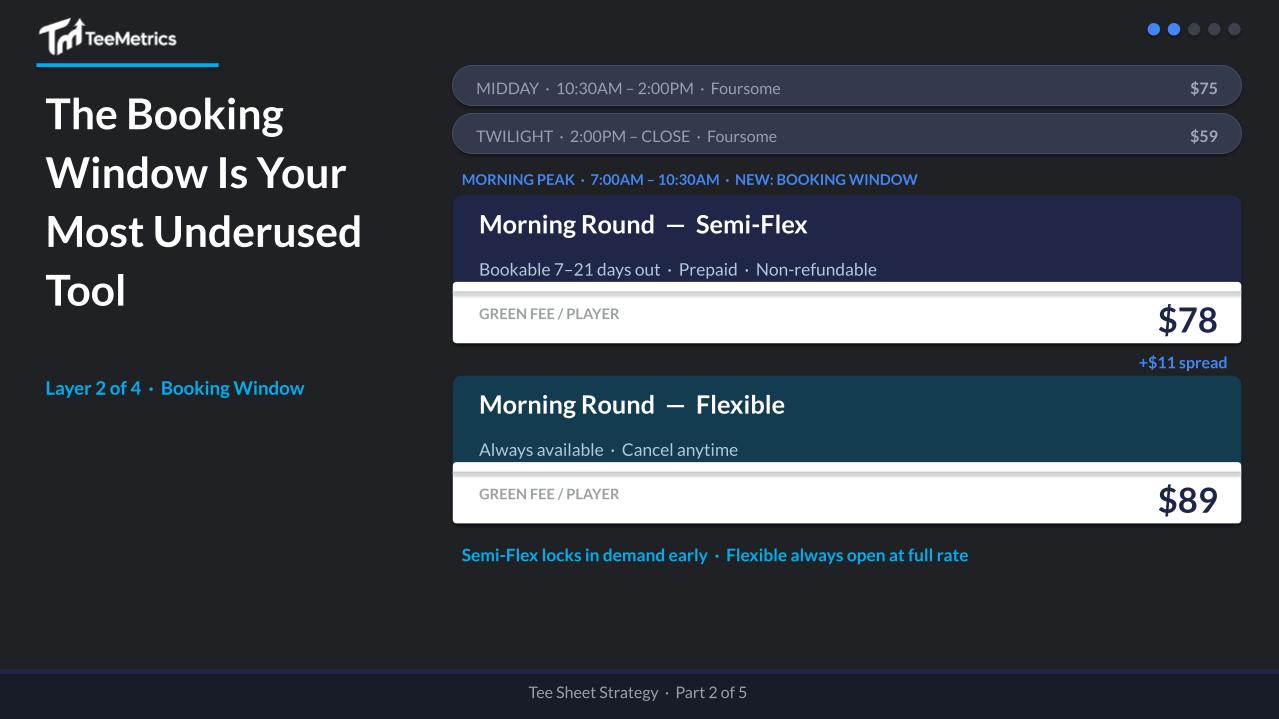
The extended window only creates value if the right product is tied to it. That product is the Semi-Flex rate: prepaid, non-refundable, but modifiable — date and time — up to 72 hours before the round. Weather rainchecks honored automatically. Only available more than 7 days out.
The modification covers date and time only. The group size they booked is the group size they play — Semi-Flex isn’t a way to downsize a foursome booking after the fact.
Non-refundable golf makes people nervous. I get it — nobody wants the angry regular calling about a rain situation, or the player whose kid got sick asking for a refund on a policy you’ve never tried to enforce. But Semi-Flex isn’t a standard non-refundable rate. A hotel non-refundable books and locks — no cash back, no changes. Semi-Flex keeps the commitment without the trap: the booking can move on date or time up to 72 hours out, and weather is always covered. What golfers actually object to isn’t committing early. It’s feeling stuck. Semi-Flex removes that objection without giving the money back.
If you’ve never run a Semi-Flex rate: start by setting it at your existing green fee and opening Flex $10 above it. Your $70 standard rate becomes Semi-Flex at $70, Flex opens at $80. Golfers who were booking casually either commit at the price they’ve always paid, or they pay $10 for the flexibility they were previously getting free. Nothing is taken away. You’re putting a price on something that had no price.
How much to discount, and when to change it
A lot of courses pick a Semi-Flex discount once — usually around 10% — and never revisit it. That leaves money on both ends: too generous when the slot would have filled anyway, not generous enough when you actually need early commitment.
The discount should track demand. Soft week: 15% off Flex. You need revenue confirmed early, so give people a real reason to commit. Normal pace: 12% moves price-sensitive planners without subsidizing slots that fill regardless. Market compressing: pull it to 9% or close Semi-Flex entirely. Stop discounting what demand is already doing for you.
| Low demand | On pace | Compression | |
|---|---|---|---|
| Semi-Flex discount off Flex | −15% | −12% | −9% |
These are starting points, not rules. A resort with guests who plan months out may find 15% actually shifts behavior. A busy daily-fee course might get the same result at 10%. Without knowing where your comp set’s Flex rates actually sit, you’re partly calibrating blind either way.
Which rates to keep open, and when to close them
Pricing is only part of it. The other piece is controlling which rate types are available on which slots, and at what stage of the window. The planned sequence: open with both Semi-Flex and Flex available, expect Semi-Flex to close as the slot fills toward peak, and treat that closure as confirmation your aggressive opening worked — not as a reactive adjustment to compression you didn’t anticipate.
Group size is another filter worth applying to Semi-Flex availability in peak windows. If Saturday morning is your highest-yield inventory, offering Semi-Flex to singles and threesomes means locking a tee time early at a discount for a group that delivers a fraction of what a foursome would. Restrict Semi-Flex to foursomes and twosomes in those slots. Singles and threesomes who want peak Saturday book Flex, or they wait. And because the group size they book is the group size they play, a foursome that commits on Semi-Flex stays a foursome — there’s no downsizing after the fact.
A Saturday 8am building fast at day 14 should have Semi-Flex pulled by day 10. A twilight slot with a consistent late-booking pattern might run Semi-Flex all the way to day 7. Neither is a fixed rule — it depends on what your specific market is doing that particular week.
In the first couple months after you launch this, track what share of your bookings in each time window are landing on Semi-Flex versus Flex. High Semi-Flex take rate on peak morning slots means you’re discounting more than you need to — tighten the gap. Low Semi-Flex on twilight means either the discount isn’t compelling enough or the advance planners aren’t there yet. The numbers tell you which direction to move. Start aggressive, let the data pull you back if it needs to.
TeeMetrics ForeSight tracks your comp set across every major booking channel, flags when demand starts building, and surfaces rate recommendations by slot. When your window is open and the market starts moving, you see it in time to act.
In Part 3: group size fencing — when to restrict, when to apply a yield offset, and how to stop peak slots from quietly giving away yield one empty seat at a time.
Ready to see your market the way a revenue manager does? Talk to TeeMetrics