
Tee Sheet Strategy, Part 4 of 5
Part 3 ended with a table. Twosome offsets running 5 to 15 percent depending on demand. Threesome and single offsets running higher. The percentages are a starting point.
How far you can push them in your specific market. That’s the calibration question Part 3 didn’t answer.
Sizing the offset
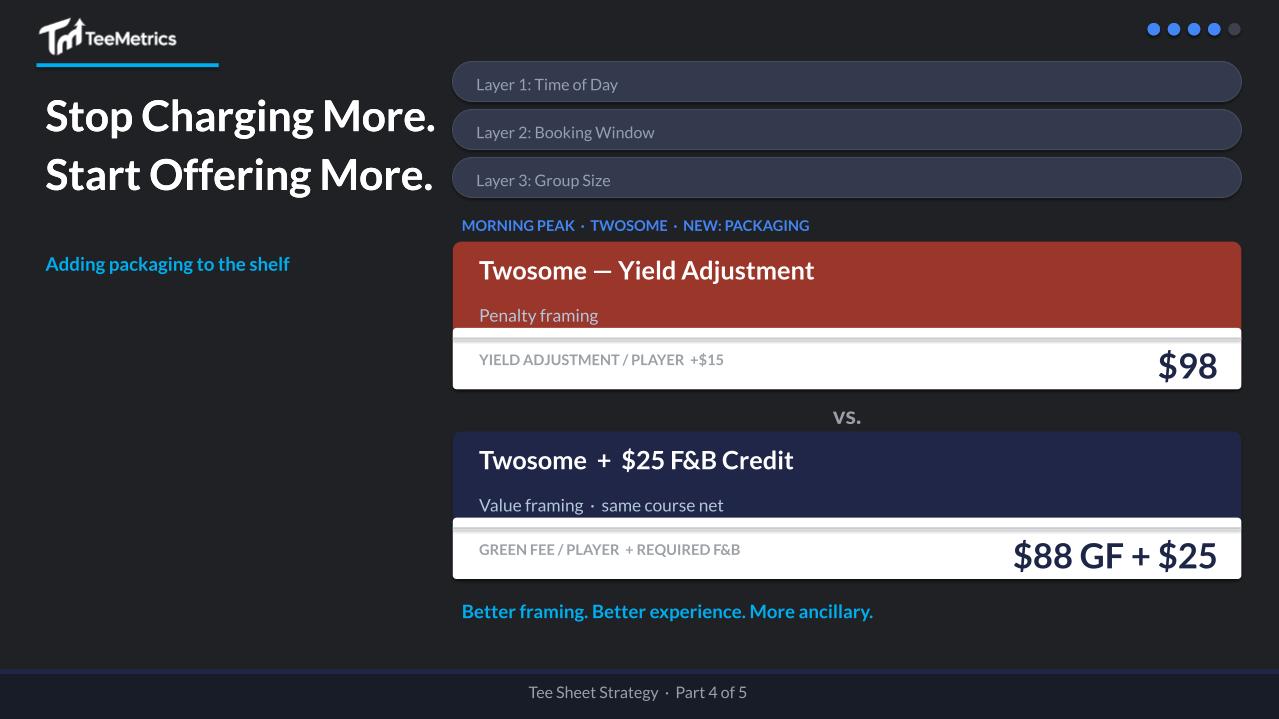
A twosome books a Saturday morning slot and sees $98 per player. A foursome books the same slot and sees $89. Neither golfer knows what the other paid. No line item, no asterisk, no explanation on the checkout screen. It’s the price for that configuration in that slot.
The question is how to set the number.
A few situations where you typically have room. These are examples, not a formula. Every market is different, and you should be testing and measuring the results rather than assuming a percentage translates cleanly from one course to the next.
You’re priced below your comp set. If courses around you are charging $95 for a weekend foursome and you’re at $89, a twosome at $98 doesn’t make you expensive. It makes you competitive with what golfers are already paying nearby.
You’re the highest-priced course in your market but also the busiest. Demand is already telling you the rate holds. A twosome offset doesn’t test that relationship. It uses it.
Your comp set is compressed. Courses in your market pricing within $15 of each other. A twosome offset doesn’t make you an outlier. It makes you the course that’s managing inventory while everyone else prices flat.
Your own booking data is a useful starting point: conversion rates by group size, falloff patterns, how far out twosomes book versus foursomes. Most operators don’t look at it closely enough. But it still can’t tell you what competitors are charging this week or how their availability is moving. TeeMetrics builds the comp set analysis around that data. That’s the direct input to calibrating this number. The right offset for a suburban market with twelve courses inside twenty minutes looks nothing like what works in a resort corridor where the spread between properties is already $40.
The value-add package
Different tool. Different logic.
Required F&B in peak slots doesn’t replace the rate offset. It layers on top of it. A twosome on Saturday morning might carry a higher base rate and a required $25 food and beverage credit. The offset closes the green fee gap. The package recovers ancillary revenue that wasn’t there before.
One thing operators don’t expect: golfers at the turn spend beyond the included credit more often than not. The $25 credit tends to generate more than $25 in actual spend. A few beers, maybe lunch. You’re not trading green fee yield for a coupon. You’re adding a margin layer on top of what the rate offset already recovered.
The package also doesn’t have to be twosome-specific. Require it for all group sizes in a peak window and you’re pulling ancillary revenue from foursomes too. Golfers who wanted that slot are booking regardless of the package requirement. You’re not losing foursomes to recover twosome yield. You’re adding a layer to every booking in the window.
Required versus optional comes down to demand.
Strong demand, peak slot: require it. The friction doesn’t cost you bookings.
Softer demand, twilight, shoulder weeks: make it optional and price it attractively. “Add $25 in F&B credit for $15 at checkout” pulls revenue from golfers who were going to eat anyway, without a gate that sends anyone elsewhere.
What using both actually looks like
Saturday morning, occupancy trending strong, two weeks out:
Foursome: $89 base, $25 F&B package required. Effective take per slot: $114.
Twosome: $98 base, $25 F&B package required. Effective take per slot: $123.
The tools compound. Rate offset handles the green fee gap. Package adds margin that didn’t exist before either way.
Shift to Tuesday afternoon with lighter demand: offset smaller or absent, package optional, structure relaxes. The goal in that window is bookings, not maximum yield per slot.
This is what operators miss when they first look at group size fencing. It’s not one setting you configure once. The configuration moves with demand. Tight when demand is strong, loose when it isn’t.
On actually running this
Yes, this is more moving parts than what most operators run today. A flat green fee is simpler. One number, no configuration decisions, nothing to monitor. But that simplicity is also why the booking window stretch from Part 2 matters as much as it does. Going from 7 to 21 days doesn’t just give you more time to capture demand. It gives you the runway to actually manage a structure like this. You can see how twosome bookings are trending two weeks out, adjust the offset if conversion is dropping, and calibrate before the weekend is already gone.
Understanding the structure is the easy part.
I’ve watched operators follow every bit of this logic, agree with it, and still not move. The hesitation is almost never confusion about the math. It’s the regular who’s played your course for fifteen years calling to say he’s never paid that much to play here. It’s restricting Saturday morning for singles knowing some of them go find another course. Those costs are immediate. The yield gap doesn’t feel that way until you run the numbers at the end of the month.
What’s sitting on the other side: holiday weekends at February rates. Peak slots filling with singles because a restriction was never set. Revenue that doesn’t come back after the weekend closes.
The operators who push through the short-term friction come out ahead. I’ve seen it. The ones who don’t leave yield sitting there unclaimed, week after week, season after season.
TeeMetrics Managed handles the execution side: comp set data updated as the market moves, rate and availability adjusted as demand shifts, packaging managed across distribution, a weekly check-in on what happened and what’s coming. The strategy isn’t the hard part. Holding rate on that Tuesday phone call, adjusting configuration when a competitor drops price. That’s where most operators need support.
Part 5 runs the full structure through three demand scenarios: same Saturday 8am tee time, three different market conditions. Next week.
TeeMetrics Managed runs your tee sheet strategy for you. Hotel-grade revenue management built for golf. Talk to us